ADA Website Compliance: Why It’s Not Optional Anymore
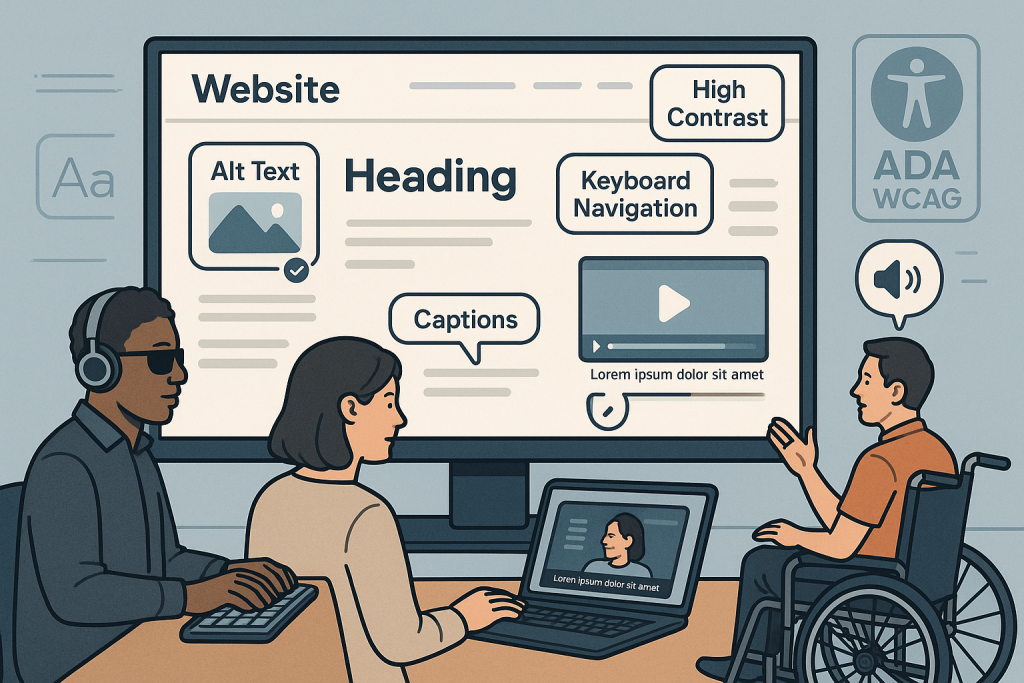
If your business has a website and you serve the public – ADA compliance is no longer optional. More than ever, courts are holding businesses accountable for having websites that are inaccessible to people with disabilities.
The Americans with Disabilities Act (ADA), originally passed in 1990, was created to prevent discrimination in public spaces. Today, that definition includes your website. If your website isn’t accessible, your business could be at risk of a lawsuit, lose customers, or damage its reputation.
What Is ADA Compliance for Websites?
The ADA doesn’t mention websites directly. But courts, lawyers, and the Department of Justice (DOJ) now interpret the law to include digital properties like websites, apps, and online tools.
This means your site must be accessible to:
- Blind or low-vision users (using screen readers)
- Deaf or hard-of-hearing users (who need captions or transcripts)
- People who can’t use a mouse and rely on keyboards or voice commands
- Users with cognitive or neurological disabilities
What Does ADA Compliance Look Like?
ADA compliance for websites usually means following the WCAG (Web Content Accessibility Guidelines) – a global standard for digital accessibility.
Some key WCAG recommendations include:
- Text alternatives for all images (alt text)
- Captions on videos and transcripts for audio
- High color contrast between text and background
- Keyboard navigation support
- Clear, consistent structure using headings and labels
If your site meets WCAG 2.1 Level AA, you’re likely on track to meet ADA website requirements
Why ADA Website Compliance Is Now Enforced
Until a few years ago, many business owners didn’t worry about digital accessibility. That’s no longer the case. The DOJ has confirmed that websites fall under Title III of the ADA, which covers places of public accommodation – including online businesses.
Now, more people are suing companies whose websites block them from basic tasks like:
- Booking appointments
- Ordering food or products
- Accessing contact forms
- Reading service information
Real Lawsuits, Real Businesses
Here are a few examples of ADA website lawsuits to show how serious this is:
- Domino’s Pizza: A blind user sued because he couldn’t place an order through the mobile app. The case went all the way to the Supreme Court—and Domino’s lost.
- Winn-Dixie: A Florida court ruled that the grocery store’s website violated the ADA because it didn’t work with screen readers.
- Thousands of small businesses: In June 2025 alone, over 305 ADA-related digital accessibility lawsuits were filed in the U.S. – and the number keeps growing.
This isn’t just a problem for big brands. Restaurants, retailers, clinics, and online stores are all being targeted.
What Happens If You’re Not Compliant?
If your website doesn’t meet ADA standards, here’s what could happen:
- Lawsuits (legal fees, settlement costs, and reputational damage)
- Loss of customers who can’t use your site
- Missed business opportunities due to poor usability
- Search engine penalties if your site structure isn’t accessible
Ignoring accessibility can be expensive. Fixing it early is far more affordable.
The Business Case for Compliance
ADA compliance isn’t just about avoiding legal trouble. It’s also:
- Smart for SEO: Search engines favor clean, well-structured, accessible content
- Good for user experience: Accessible sites are easier to use for everyone
- Helpful for business growth: You open your doors to millions of people with disabilities
- A sign of brand values: It shows you care about inclusion and fairness
What You Can Do Today
You don’t need to rebuild your whole site overnight. Start with these steps:
- Run an accessibility audit
- Fix basic issues like alt text, headings, and contrast
- Add captions to videos and labels to forms
- Work with an accessibility consultant if needed
- Document your efforts—show you’re working toward compliance
It’s About Equal Access
ADA website compliance is no longer a gray area—it’s a legal requirement and a moral obligation. Whether you run a local business, a growing e-commerce store, or a nonprofit, your website should work for everyone.
Accessibility is not a tech feature—it’s a human right. Start making your website more inclusive today.
Need help reviewing your site or building an ADA-compliant website from scratch?Reach out to our team for a simple audit or hands-on support.
 X
X Facebook
 LinkedIn